
|
O, swear not by the moon, the fickle moon, the inconstant moon, that monthly changes in her circle orb, Lest that thy love prove likewise variable –- Shakespeare's Juliet speaking to Romeo, Act 2, Scene 2. And if she faintly glimmers here, And paled is her light, Yet alway in her proper sphere She's mistress of the night. –- Henry David Thoreau, 1843 — 1916 Inconstant Moon or in Her Proper Sphere? To understand the moon’s predictably peripatetic motion, let’s first focus on the eastward (west to east) rotation of the earth. Later we will look at how this affects apparent movement of sun and moon, and, in a future topic, the actual movement of tides and winds (Coriolis effect). We are setting a foundation for understanding time zones, International Dateline, moon, tides, and weather. It all starts with the earth’s rotation. The sun also ariseth, And the sun goeth down, And hasteth to his place where he ariseth. –- Ecclesiastes 1.5. JPS 1917 translation After night, we see the sun rise in the east because we move with the earth eastward toward sunlight. After noon, our eastward journey takes us away from the sun until the western horizon rises up to obscure the sun at nightfall. In contrast to this actual earth rotation, we experience an apparent transit of sun moving westward (east to west) rising from the east and setting in the west. While we know the earth is moving eastward, it is convenient and conventional to speak of the sun transiting westward. The moon also rises and sets. The moon, like the sun, rises in the east and sets in the west. If you see the moon above the eastern horizon, it must be rising. If you see the moon above the western horizon, it must be setting. The apparent motion is always from east to west. If that seems too obvious to say, consider this tale of my confusion. On night watch in 2006 on a voyage to the Marquesas, I saw predawn clouds glowing red, and immediately thought of welcoming dawn. The moon, having been hidden all night by storm clouds, was not on my mind. Slowly, to my sleep deprived mind, the “dawn” I was expecting was occurring in the west. Had I missed a gap of time, was this sunset instead of dawn? All I could think of was the sun. It felt like the end of the world.“What is going on?” I asked myself. Slowly the facts became clear. The storm clouds had parted at the western horizon, revealing a blood red full moon setting there. Soon after on the eastern horizon came rosy-fingered dawn (The Odyssey). There had been no apocalypse when “the sun became black as sackcloth of hair, and the moon became as blood; And the stars of heaven fell unto the earth.” (Revelation 6, 12 & 13, King James translation). Let us now compare sun with moon. Petruchio. ... Good Lord, how bright and goodly shines the moon! Katherina. The moon? The sun! It is not moonlight now. Petruchio. I say it is the moon that shines so bright. Katherina. I know it is the sun that shines so bright. — Shakespeare’s “The Taming of the Shrew” SUN
Note 2 on Libration: https://en.wikipedia.org/wiki/Libration Here is a sequence of moon phases. https://science.nasa.gov/science-news/science-at-nasa/2002/12apr_earthshine https://earthobservatory.nasa.gov/IOTD/view.php?id=83782 New – Not visible. Up all day. Rises and sets with the sun. Early WAXING CRESCENT. Rises soon after sunrise and sets soon after sunset. Here after sunset with earthshine (light reflected from earth). 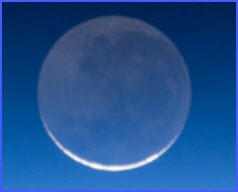 Early Waxing Crescent WAXING CRESCENT. Rises before noon and sets before midnight. 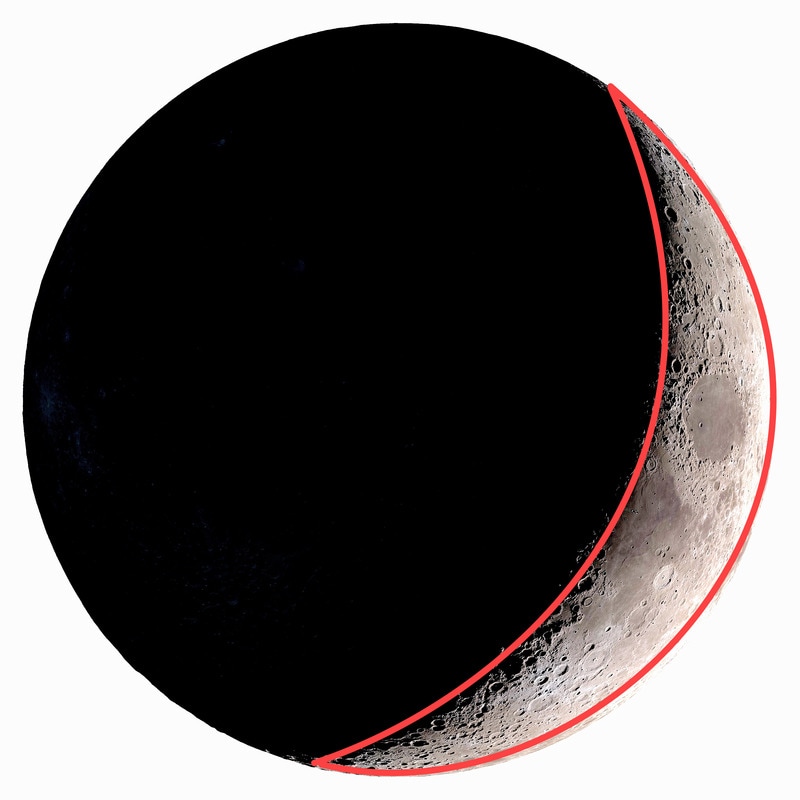 Waxing Crescent FIRST QUARTER. While one half of the whole moon is receiving sunlight, half of that sunlit moon is on the far side of the moon not visible to earth. From earth, only a quarter of the moon is seen in sunlight. Think of a quarter section of an orange. Rises at noon, highest at sunset, sets around midnight. 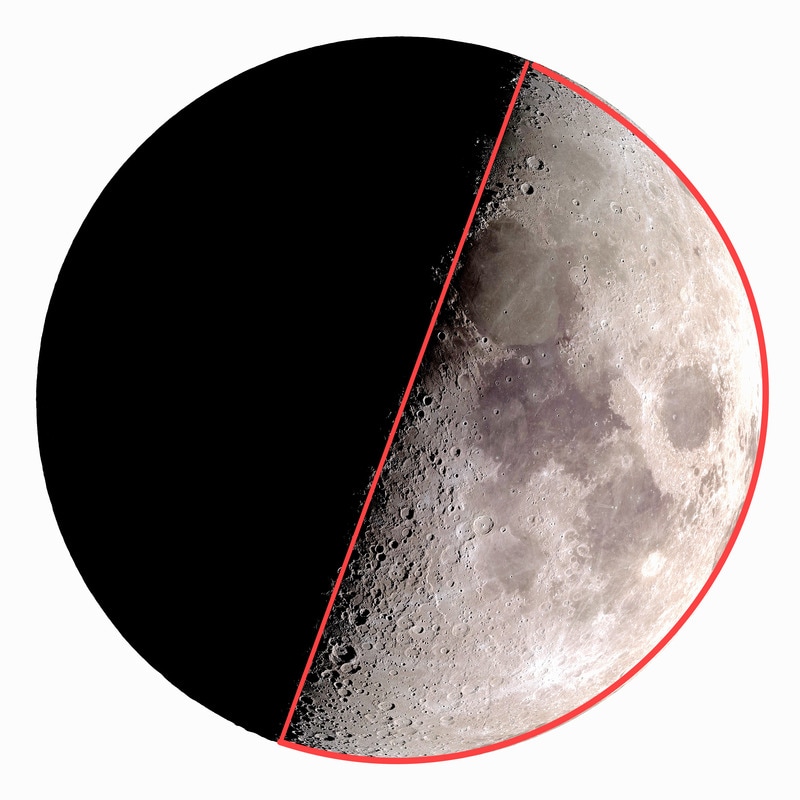 First Quarter WAXING GIBBOUS. Rises in late afternoon before sunset. Up through most of the night. Sets before sunrise. To see it in daylight, look to the east in the afternoon to see it rising. 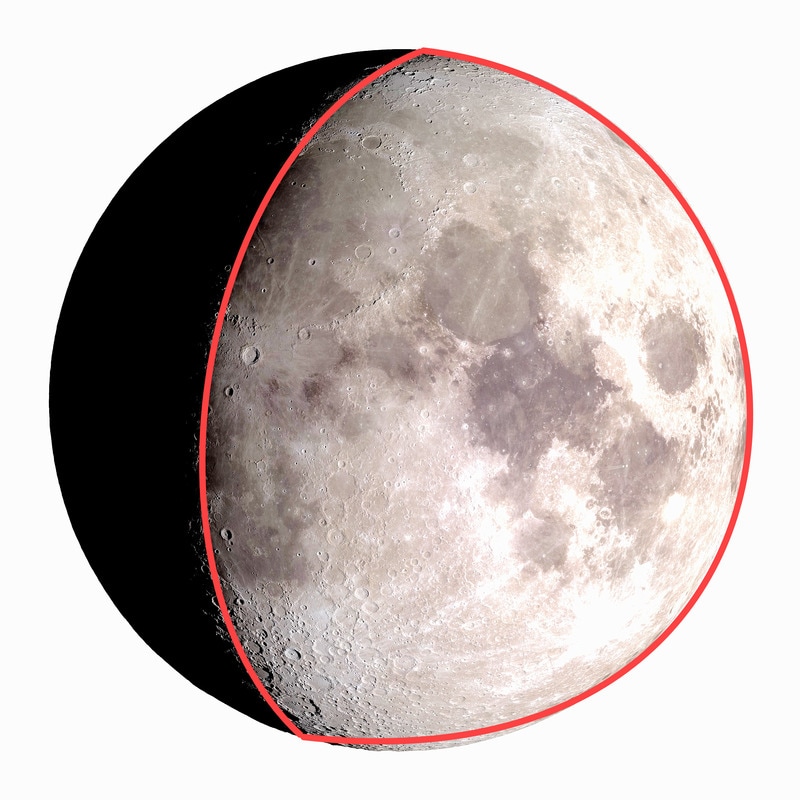 Waxing Gibbous FULL. Up all night from sunset to sunrise. The entire earth facing hemisphere is sunlit. 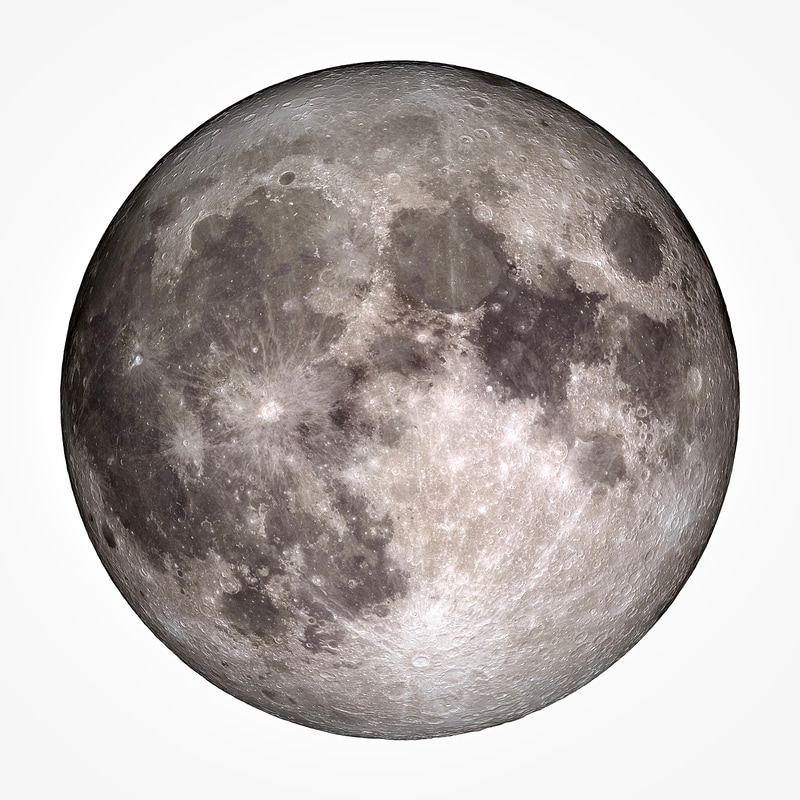 Full Moon WANING GIBBOUS. Rises after sunset and is up for the rest of the night and into the morning. Sets after sunrise. To see it in daylight, look west after sunrise before it sets. 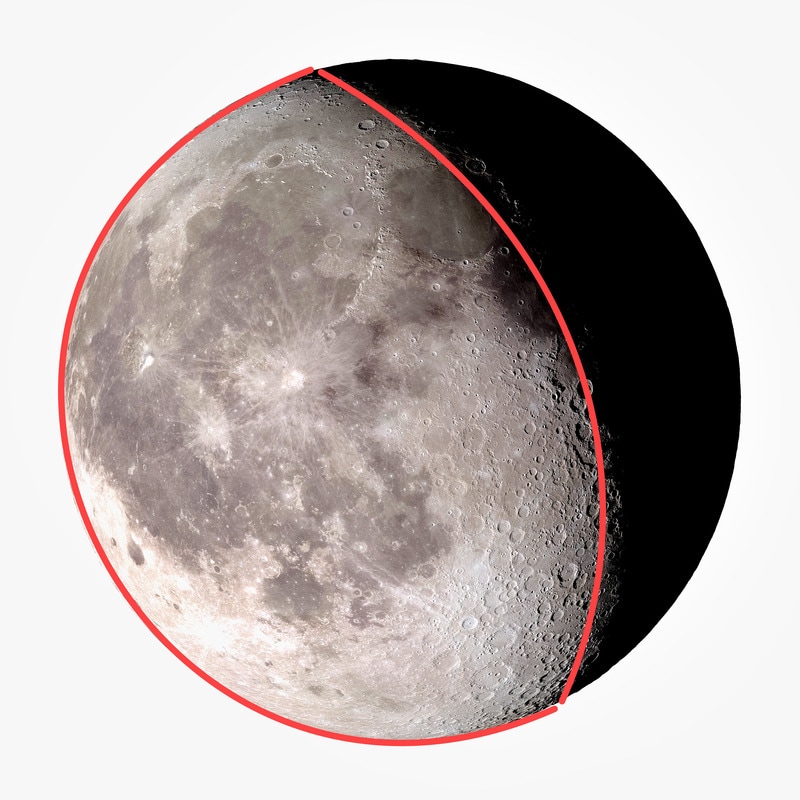 Waning Gibbous THIRD QUARTER. Rises at midnight, highest at sunrise, sets around noon. 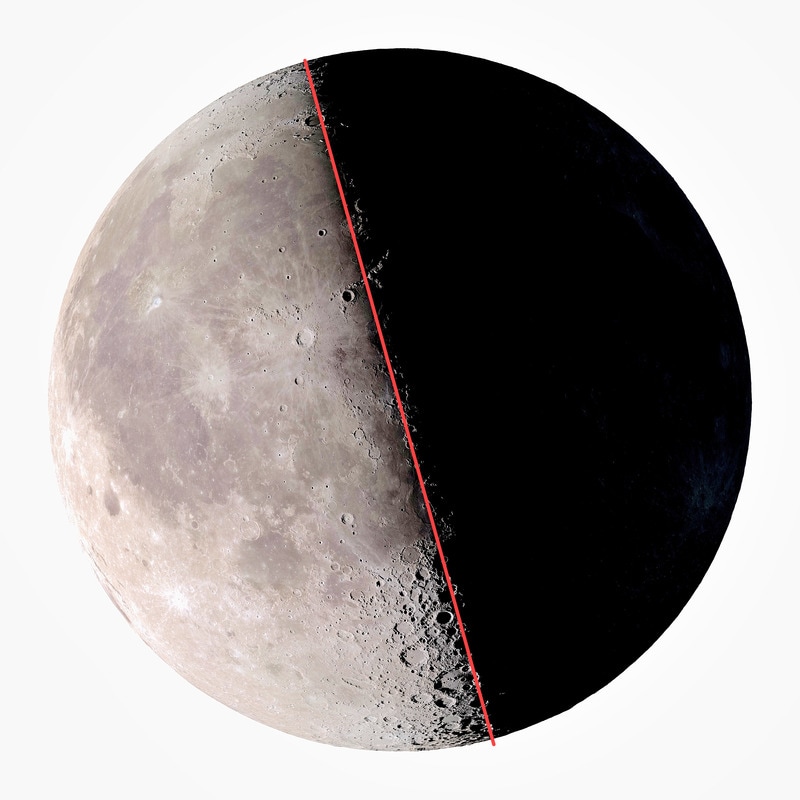 Third Quarter WANING CRESCENT. Rises before dawn and is up for most of the day, setting before sunset. 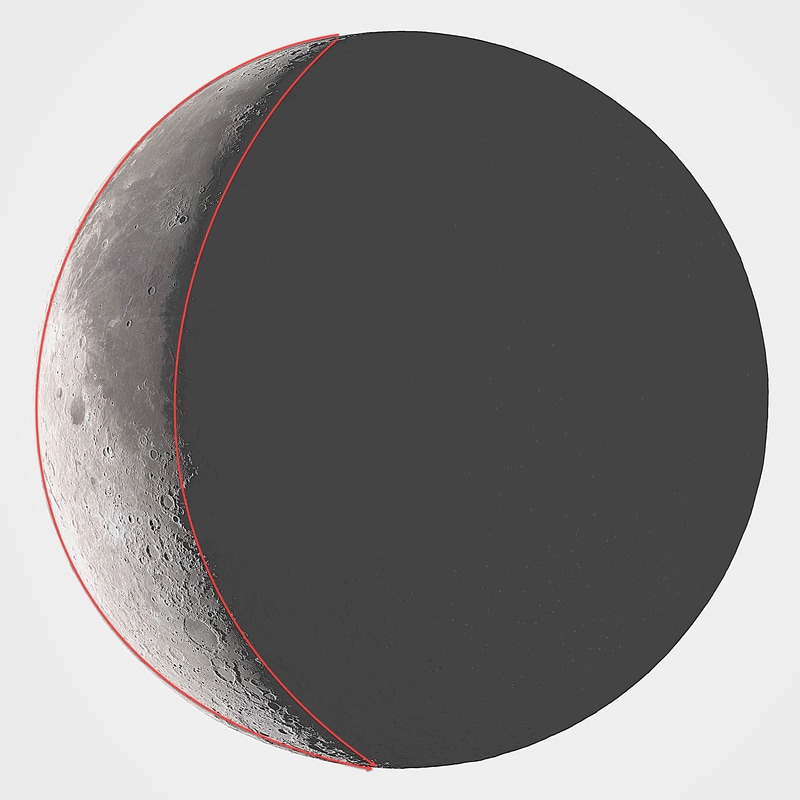 Waning Crescent Summary chart of the moon phases 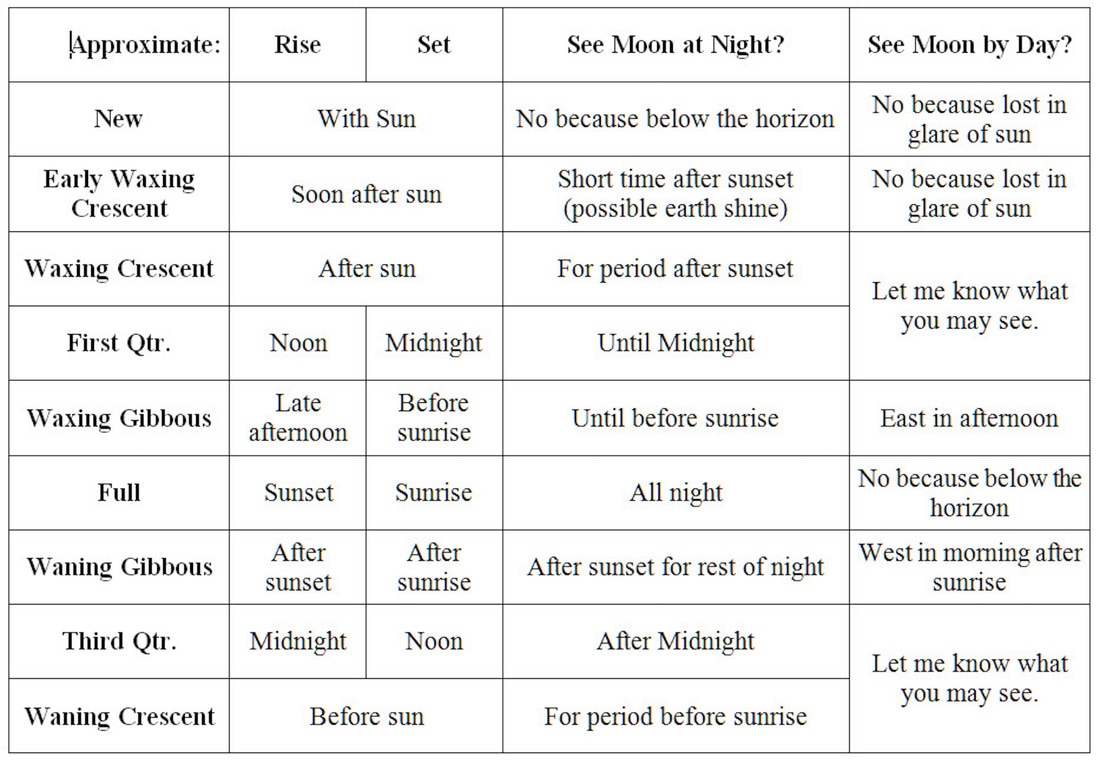 We have compared the sun and moon and then looked at moon phases. To prepare for studying tides in a latter article, think now of moon and sun together. Here is a diagram from Bowditch Chapter 15, “Navigational Astronomy”, Section 12 “The Moon” pages 223 to 224 available from the Maritime Safety Office of the National Geospatial-Intelligence Agency at: http://msi.nga.mil/MSISiteContent/StaticFiles/NAV_PUBS/APN/Chapt-15.pdf as copied below with permission for non-commercial use. http://msi.nga.mil/NGAPortal/MSI.portal?_nfpb=true&_pageLabel=msi_comm_use_warning  What matters for tides is to see that with a New Moon and Full Moon the moon and sun are on the same line which makes for greater tidal change (spring tide). The name for this with a New Moon is “conjunction” (moon between sun and earth) and the name with Full Moon is “opposition” (moon on opposite side of earth from sun). The quarter moons are at a right angle to line between earth and sun (quadrature) making for least tidal change (neap tide). For a more detailed diagram with further explanation see: http://www.moonconnection.com/moon_phases.phtml For a web moon phase calendar see: http://www.moonconnection.com/moon_phases_calendar.phtml For $29.95 you can purchase moon phase predicting software (for Windows or Mac) at http://www.quickphase.com/ The software author makes the same functionality available for free for cell phones. http://www.lunasolaria.com/ For a bio of the software’s author see https://www.bluemarmot.com/about.phtml?ws=bm https://www.bluemarmot.com/ If you want tables of moon and sun rise and set times, the Navy provides them (in Standard Time only): http://aa.usno.navy.mil/data/docs/RS_OneYear.php To see media’s earth rotation direction blunders: http://ew.com/article/1992/03/13/earths-rotation/ To learn more about moon phases and check my writing for errors: http://earthsky.org/moon-phases/understandingmoonphases https://svs.gsfc.nasa.gov/4236 http://www.astronomy.com/magazine/ask-astro/2015/09/moonrise-times http://curious.astro.cornell.edu/about-us/46-our-solar-system/the-moon/observing-the-moon/128-how-does-the-position-of-moonrise-and-moonset-change-intermediate A final thought: If the illuminated portion of the moon as seen from Southern Hemisphere is on the left side of moon, then in the Northern Hemisphere it will be seen on the right, and vice versa. 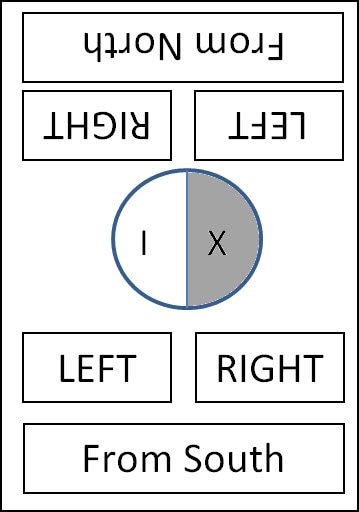 http://moongazer.x10.mx/website/astronomy/moon-phases/
http://curious.astro.cornell.edu/about-us/46-our-solar-system/the-moon/observing-the-moon/135-does-the-moon-look-different-in-the-northern-and-southern-hemispheres-beginner Consider the following two related matters: The confusion of perspective is why starboard is a name used for an actual side of a boat as compared with the concept of “right” which changes with the perspective of the observer. Avoiding confusion is critical in avoiding collisions at sea. Cyclones spin in opposite directions on opposite sides of the equator. This is something to examine in future articles.
0 Comments
Leave a Reply. |
From the admiral's chairJohn Berol is the husband of Captain Diane. He commissioned Celtic Song in 2005, has sailed extensively and maintains an active interest in both the boat and her captain. He believes the more you know, the better you will sail. The term “Admiral’s Chair” is a family joke. For just as every writer needs an editor, so every captain needs an admiral. Archives
March 2021
Categories |
 RSS Feed